You came in wired for connection.
Not as a preference. As a biological requirement. Before you had language, before you had strategies, your nervous system was reaching — for attunement, for contact, for the signal that said: you're safe, you're here, you belong.
There's a well-known experiment in developmental psychology called The Still Face Experiment. An infant sits across from a caregiver. Everything is normal — smiles, sounds, response. Then the adult goes blank. No reaction. Nothing returned.
What happens next is consistent. The baby doesn't give up immediately. It tries harder. Smiles bigger. Reaches more. Works to restart the exchange. When nothing comes back, it fuses, turns away, shuts down.
That sequence is the seed of every performance trap. The nervous system learns, over time, that reaching doesn't reliably work. And so it stops trusting reaching — and starts performing instead.
"Just being was not enough to stay connected. Something had to be done. Something about you had to change to keep the connection. That adjustment kept you alive. It also became the seed of your performance trap."
This is where the model begins. Not with ambition. Not with achievement. With a child who learned that love had to be earned.
Seven layers. One story.
The Performance Trap Framework reads the natal chart the way a detective uses a case file — not as prediction, but as pattern recognition. Each layer maps a specific moment in the story of how a person learned to contort themselves to belong.
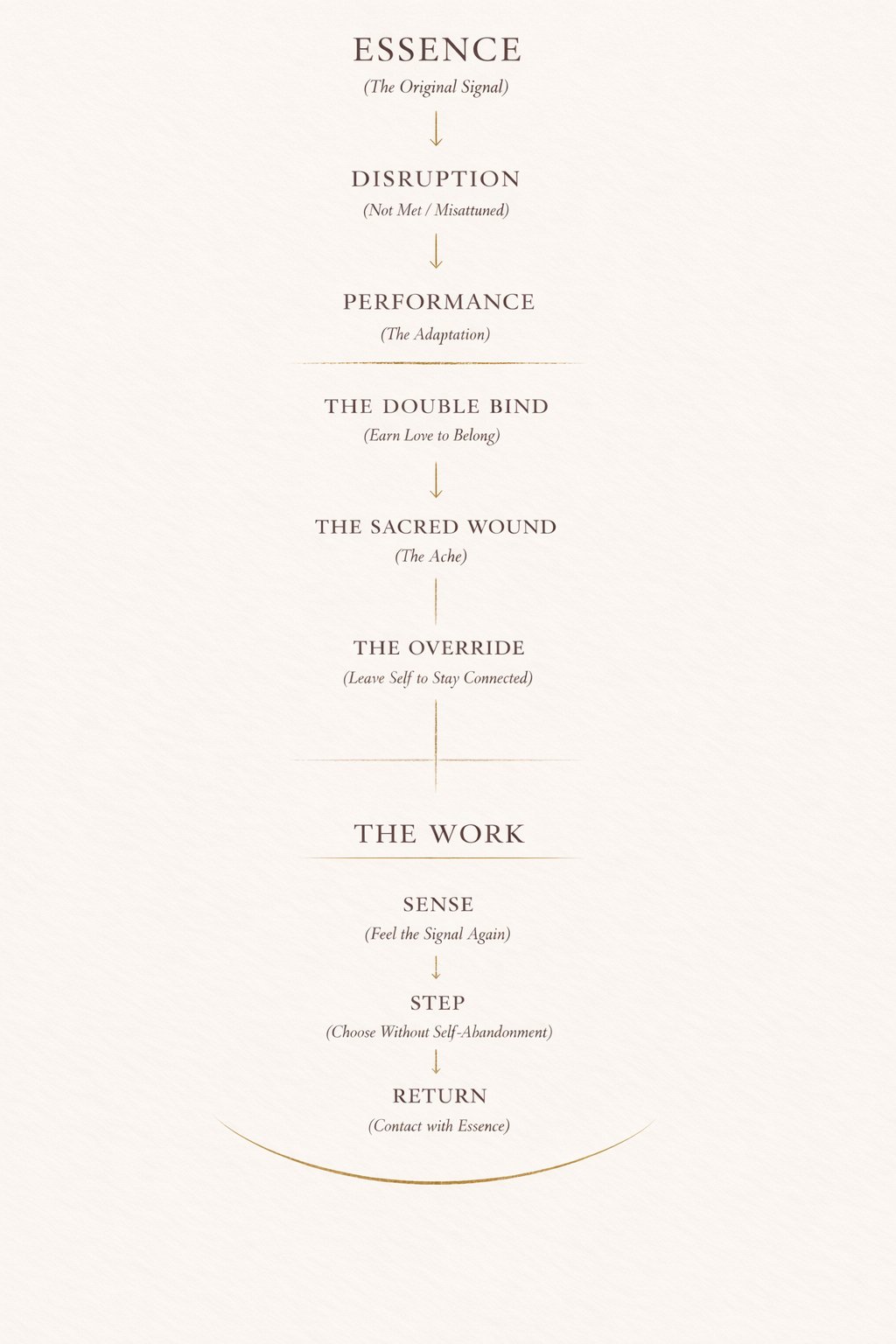
The architecture behind every reading.
Why it holds. And why it doesn't have to.
The trap doesn't stay in place because you're weak. It stays because of time travel.
When a text message, a silence, a piece of feedback triggers a disproportionate spike of panic — you're not reacting to what's happening now. You're back in the moment when your performance was the only thing keeping the bond alive. The present collapses into the past, and the old strategy takes the wheel.
That's the mechanism. And it's also the opening. Because once you can feel the time travel happening — once you can sense the moment the chest tightens and the old reflex fires — you have a choice that didn't exist before.
"You think you have to choose between connection or your own truth. But there is a third option: staying related to the other while staying true to yourself."
Not fight. Not submit. Something that didn't exist in the original environment — the capacity to stay connected without abandoning yourself in the process.
That's what the Work section of the architecture points toward. Not a cure. Not a personality transplant. A set of reps that, practiced over time, teach the nervous system a new truth: you can feel this without leaving yourself. You can stay in relationship without signing the old contract.
Your specific map. Your specific trap.
The natal chart is a case file. It contains the coordinates of when you first learned that just being wasn't enough — and what you built around that moment. Not because the planets caused any of it. But because the moment you arrived, a particular configuration of conditions was in place, and those conditions left a traceable pattern.
The Map That Was Chosen For You reads those coordinates and maps your specific version of the performance trap — how it formed, what it costs you, where the way out is. No astrology knowledge needed. No belief required. Just pattern recognition.
Ready to see your map?
Enter your birth details. Receive a reading specific to you. Takes about 60 seconds to fill out.